

Article: How to Review a Custom Clothing Contract Before You Sign
How to Review a Custom Clothing Contract Before You Sign
Quick Summary
A custom clothing contract should clearly describe the garment, fabric, and measurements, state the total price and payment schedule, and set a firm delivery date. It should also explain how changes, fit problems, refunds, and delays are handled. Get every term in writing before you pay a deposit.
- Confirm the garment, fabric, color, and measurements are written out in full.
- Find the deposit amount and the exact trigger that makes it non-refundable.
- Require written approval and a revised price and date for every change order.
- Define what counts as a late delivery and what remedy you receive.
- Check which party bears the risk of loss if the garment is damaged in transit.
Table of Contents
- How to Review a Custom Clothing Contract Before You Sign
- What a Custom Clothing Contract Covers and Why It Matters
- Tailor Agreement vs. Manufacturer Production Agreement: Know Which You Are Signing
- Scope, Design Specifications, and Measurements Clauses
- Custom Garment Payment Terms: Deposits, Balances, and Refunds
- How to Read a Custom Apparel Quote Before You Agree
- Changes, Fit Disputes, Delays, and Remedies
- Using a Custom Clothing Contract Template and Booking Your Order
- Frequently Asked Questions
How to Review a Custom Clothing Contract Before You Sign
Last Updated: November 2, 2026
What a Custom Clothing Contract Covers and Why It Matters
A custom clothing contract is the document that turns a design idea into a binding order.
A custom clothing contract protects both sides. It spells out the garment, the price, the payment schedule, the timeline, and the process for fittings and changes.
What the contract should answer:
- What exactly is being made, and in which fabric and color?
- What does the total price include, and what could add cost later?
- Who fixes a fit problem, and at whose expense? For tips on getting the fit right from the start, see practical guidance on ensuring a perfect fit.
Read the contract as a checklist. If any of these questions has no clear answer, ask before you sign.
Tailor Agreement vs. Manufacturer Production Agreement: Know Which You Are Signing
Not every custom order uses the same kind of contract. A tailor agreement usually covers one client and one garment, with fittings built into the process. A manufacturer production agreement often covers a run of pieces, with terms set around quantity, factory schedules, and quality inspection.
Watch for these differences:
- Fittings: Tailors typically include them. Manufacturers often do not.
- Quantity: Tailor orders are usually single pieces. Production agreements may include minimum order quantities.
- Changes: A tailor can adjust a fit more easily. A factory run may treat any change as a new order.
Knowing which agreement you have tells you which protections to expect.
Scope, Design Specifications, and Measurements Clauses
The scope clause describes the garment in detail. Look for the style name, fabric, color, print placement, length, and any trims or lining.
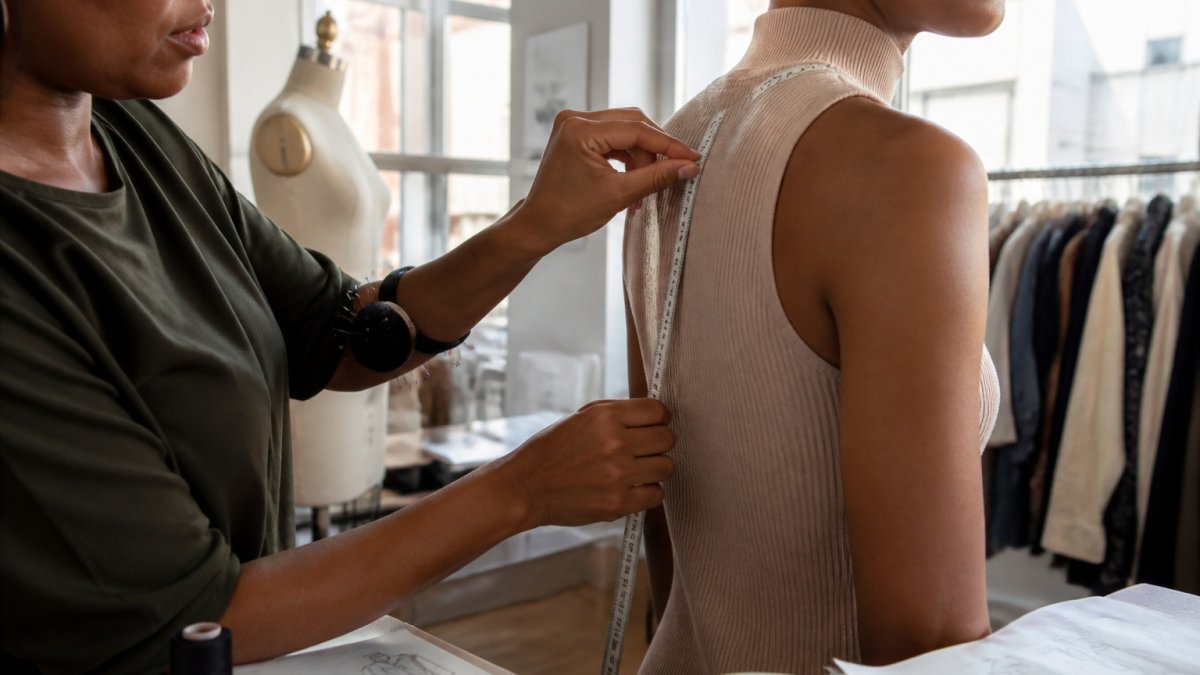
Measurements matter just as much. Check that the contract lists your bust, waist, hip, and length numbers, and confirm who took them.
Ask the business to confirm in writing:
- The exact measurements used and the date they were taken
- Whether a fitting or sample is included before final production
- Who approves the design, and how you sign off
For a clear way to take your own numbers, see our guide to How to Measure for Formal Dresses: A Complete Guide.
Custom Garment Payment Terms: Deposits, Balances, and Refunds
Payment terms are where most custom clothing disputes actually start, because money changes hands long before the garment exists. The contract should read like a schedule, not a sentence: each payment tied to a specific milestone, a specific amount, and a specific date or trigger.
The four numbers to find in every payment clause:
- Deposit amount and trigger. How much is due to start work, and what event starts it, signing, fabric purchase, pattern cutting, or a scheduled date?
- Interim payments. On larger orders, is there a second payment at sample approval or at the start of production?
- Final balance trigger. Is the balance due on completion, on shipping, on delivery, or on your approval after a fitting? "Due before shipping" and "due on delivery" are very different risks for you.
Deposit amounts and payment triggers vary by maker. What matters is that the percentage and the trigger are both written down.
Why deposits are often non-refundable, and when that is fair
A maker who starts work immediately spends money on your behalf: fabric and trims cut to your order, pattern work, and production time reserved that cannot easily be resold.
Watch out: a clause that says the deposit is "non-refundable" with no stated trigger can be read to mean it is non-refundable the moment you sign, even if the maker has not bought anything yet.
Cancellation and refund mechanics
Look for a cancellation clause that answers four things in order:
- Who can cancel, and how. Written notice to a named person or email address, with the date the notice is effective.
- What happens before work starts. Typically a full refund minus any documented third-party costs already incurred.
- What happens after work starts. Often a partial refund based on work completed, or forfeiture of the deposit plus payment for materials already purchased.
- What happens after completion. Usually no cancellation right once the garment is finished and approved, only the remedy provisions for defects or fit.
If the contract is silent on cancellation, you are relying on whatever default rules apply in your state, and those may not match what either side assumed.
Payment method, timing, and proof
- Method. Confirm which methods are accepted and whether any carry a processing fee that gets passed to you.
- Receipts. Require a written receipt for every payment, showing the amount, date, and what milestone it satisfies.
- Late fees and interest. If the contract imposes a late fee on your balance, check the rate and the grace period; if it imposes nothing on the maker for a late delivery, note the asymmetry.
How payment terms differ between a tailor and a manufacturer
Billing structures differ between tailor and manufacturer agreements, so confirm exactly how each payment is tied to a milestone and whether any charges sit outside the quoted price.
Get every one of these answers in writing before you pay anything. A verbal promise about a refund is very hard to enforce once the money has moved.
The article breaks payment terms into four numbers every contract should state:
| Payment term | What to check | Why it matters |
|---|---|---|
| Deposit amount and trigger | How much is due, and what event starts work | Shows when money becomes at risk |
| Interim payments | Payment at sample approval or production start | Spreads risk on larger orders |
| Final balance trigger | Due on completion, shipping, delivery, or approval | Decides when you pay for the garment |
| Refundability of each payment | Which payments are refundable and under what conditions | Defines what you can recover if you cancel |
How to Read a Custom Apparel Quote Before You Agree
A quote should show a clear price breakdown. Look for the base garment price, any custom design or print fees, rush charges, alterations, and shipping. Pricing depends on quantity, dates, and delivery, so ask for a written quote tied to your specific order.
Watch for costs that appear late, such as rush or expedited charges, so you can confirm them before you agree.
Compare each quote against this list:
- Garment price and any fabric upgrades
- Design, print, or embroidery fees
- Number of fittings included
For current prices or a quote on your order, contact KAHINDO directly through kahindo.com.
Changes, Fit Disputes, Delays, and Remedies
This is the section most custom clothing contracts handle worst, and the one that decides whether a problem becomes a fix or a fight. Three risks need their own clauses: changes to the order, fit and approval, and delay or failure to deliver.
Change orders and scope creep
A change order is a written amendment to the original order, a different fabric, an added piece, a revised neckline, a larger quantity.
What the change clause should say:
- Who can request a change and to whom the request must go.
- How the change is priced, at a stated hourly rate, at cost plus a margin, or by a revised quote.
- How the schedule moves. A change made after cutting or dyeing often adds weeks, not days.
Watch out: a contract that lets the maker accept changes "as needed" without your written approval can leave you paying for alterations you never agreed to. If a fit problem has already appeared, see common clothing fit issues and how to fix them.
Measurement responsibility and fitting rounds
Fit disputes usually turn on one question: who was responsible for the measurements? The contract should state whether the maker takes measurements, whether you supply them, and what happens if the numbers you supply produce a poor fit.
- If the maker measures, the contract should say the garment will be made to those recorded measurements, and that the maker bears responsibility for fit against them.
- If you supply measurements, the contract may limit the maker's responsibility to matching your numbers, not to how the garment feels. That is a meaningful shift of risk onto you.
- Fitting rounds. Specify how many fittings are included, whether they are in person or virtual, and what happens if more are needed, who pays, and how much notice is required.
Delays, damaged goods, and supplier failures
Delay clauses should do more than name a date. They should define what counts as late, what notice the maker must give, and what remedy you get.
- Delivery date and definition of late. A date plus a stated grace period, and whether the date is a ship date or a delivery date.
- Notice of delay. How far in advance the maker must tell you, and in what form.
- Remedies. Common options include a repair, a remake, a partial refund, or a discount, name which applies and when.
Dispute resolution and governing law
Finally, check how the contract handles a disagreement. Look for the governing law (usually the state where the business operates), whether disputes go to negotiation, mediation, or arbitration before court, and who pays fees. If the contract requires arbitration in a distant location or waives your right to court, that is a term to weigh before signing. For a high-value order, it is worth having a local attorney review the dispute clause specifically.
Checklist for this section:
- Change orders require written approval and a revised price and date
- Measurement responsibility is stated, with fitting rounds and who pays for extras
- Acceptance criteria for fit are defined
Using a Custom Clothing Contract Template and Booking Your Order
Many clients start from a custom clothing contract template. A template saves time, but make sure it matches your order. Replace any generic terms with the specifics of your garment, dates, and payment plan.
Before you book, use this short checklist:
- The garment, fabric, and color are described in full
- Measurements and fitting terms are written out
- The total price and deposit are clearly stated
When the terms match your expectations, you can book with confidence. If your event is close, ask about timing first. Shop KAHINDO's current collection and request a quote at kahindo.com to start your custom order.
Frequently Asked Questions
What should a custom clothing contract include?
A solid custom clothing contract names both parties, describes the garment and its quantity, lists design specifications and measurements, and states the unit price or quote basis in USD. It should also cover the deposit, the payment schedule, the production timeline with a delivery date, the approval point for samples and fittings, how revisions are priced, and what happens if either side cancels. Check that it says who supplies fabric and trims and who owns the design. Pricing depends on quantity, dates, and delivery, so confirm current prices directly with KAHINDO.
What are the red flags in a custom garment contract?
Watch for vague scope language such as 'approximately' measurements, no written sample or fit approval step, and deposits described as fully refundable with no terms. Be cautious of contracts with no delivery date, no remedy if the garment does not match the approved design, or unlimited free revisions with no change-order process. Clauses that shift all risk to the client for delays or damaged goods also deserve a closer look before you sign.
Should a custom clothing contract include a cancellation or refund policy?
Yes. The contract should state whether the deposit is refundable, when cancellation fees apply, and how much of the order is already committed once production starts. Custom garments can involve fabric and labor before the client sees the finished piece, so ask whether the deposit is refundable. Ask for the policy in writing and confirm it before paying. Ask about the return and exchange policy before ordering, and read that section carefully.
Who owns the design under a custom clothing agreement?
The contract should state who holds the rights to the design, pattern, and artwork. Some agreements give the client rights to a one-off garment only, while others keep the design with the maker. If you want exclusivity or the right to reproduce the design, that must be written into the agreement. Ask for this language to be clear before you commit to the order.