



Most Ethical Luxury Brand: How to Judge Any Label
Table of Contents
- Why 'Most Ethical' Has No Single Winner
- The Ethical Luxury Scorecard: 7 Criteria That Matter
- Ethical Fashion Certification Standards That Carry Weight
- How to Verify Ethical Fashion Claims Yourself
- What Artisan-Made Luxury Clothing Looks Like in Practice
- The Greenwashing Audit: Four Claims That Fail
- Cost-Per-Wear and Resale: The Money Side of Ethics
- Conclusion
- Frequently Asked Questions
Last Updated: September 13, 2026
Why 'Most Ethical' Has No Single Winner
No single luxury brand wins the title of most ethical, because ethics in fashion is a spectrum measured across materials, labor, animal welfare, and transparency, not a trophy one label holds forever. The better question is which brands let you verify those claims yourself. This guide from KAHINDO walks through the criteria, the certifications, and the audit questions that separate real ethical luxury from marketing copy. Below, we'll show you exactly how to judge any label in about ten minutes.
The Ethical Luxury Scorecard: 7 Criteria That Matter
Ethical luxury is a standard, not a slogan: a luxury garment qualifies as ethical when its materials, labor, animal treatment, and supply chain can be independently verified rather than simply asserted. Score every brand you're considering against these seven criteria:
- Material sourcing, organic, recycled, or traceable fibers with named origins
- Environmental impact, dyeing, water use, and waste reduction practices
- Labor practices, documented living wages and safe conditions
- Animal welfare, clear policies on leather, fur, and down
- Supply chain transparency, disclosed factories, cooperatives, or artisan groups
- Third-party certification, independent audits, not self-reported claims
- Circularity, repair, resale, or take-back programs
A brand that scores well on two or three criteria and stays silent on the rest is usually telling you where its weaknesses are.
Materials and Environmental Impact
What matters most here is whether a fabric's origin can be traced and whether its production reduces harm. Organic textiles, recycled fibers, and low-impact dyeing all count; vague "eco-friendly materials" language does not. Slow-bath dyeing, for example, produces unique gradients. Textile Exchange's Materials Benchmark tracks how major fibers perform on environmental impact, and it's a useful benchmark for judging a brand's fabric story.
Labor Practices, Living Wages, and Animal Welfare
Fair trade and living wage commitments only count when they're documented, not implied. Ask whether the brand names its production partners, publishes wage standards, and states an animal welfare policy covering leather, fur, and down. Artisan cooperatives with named workers and recorded labor hours are a strong signal; "ethically made" with no further detail is not.
Ethical Fashion Certification Standards That Carry Weight
A certification only carries weight when an independent body, not the brand's marketing team, issues it, defines the standard, and can revoke it. The logos below are the ones worth checking first, but the logo itself is not the point. What matters is whether you can look up the certificate number and confirm the scope of what was actually audited.
- Fair Trade Certified, audited labor and wage standards, with a certification mark tied to a specific product and supply chain rather than the whole company
- GOTS (Global Organic Textile Standard), organic fiber processing from field to finished textile, with a transaction certificate that traces a specific batch
- B Corp, verified social and environmental performance across the whole company, scored and re-certified on a cycle rather than granted once
- OEKO-TEX, tested for harmful substances at the material or product level; note that STANDARD 100 covers the finished article while MADE IN GREEN adds facility and traceability requirements
- Cradle to Cradle, material health and circularity, graded at Bronze, Silver, Gold, or Platinum across five categories
- Responsible Wool Standard and Recycled Claim Standard, fiber-specific chain-of-custody standards that follow the material from farm or recycler to finished good
A brand with one certification and a clear supply chain beats a brand with five logos and no traceability. The reason is scope: a single GOTS transaction certificate tells you a specific fabric was processed to a defined standard, while a wall of badges often means each one covers a different facility, product line, or subsidiary, and none of them covers the garment you are actually looking at.
How to Verify a Certification in Under Five Minutes
- Get the certificate number. It is usually printed on the hangtag, the product page, or the brand's impact report, not just the logo image.
- Go to the certifier's own directory. B Lab's certification directory lets you confirm a B Corp claim in seconds; GOTS, OEKO-TEX, and Fair Trade Certified each publish their own searchable databases.
- Check the scope line. Does the certificate cover the brand, a specific factory, or a single product? A facility-level certificate does not vouch for the brand's other suppliers.
- Check the expiry date. Certifications lapse. An expired certificate is a historical fact, not a current claim.
- Look for the certifier's name, not just the standard's name. "Certified" without a named body is a self-report wearing a badge.
The Certification Gaps Competitors Do Not Mention
Most certification roundups stop at the logo list. Three gaps matter more than the list itself:
- Certifications cover processes, not outcomes. GOTS verifies organic fiber processing; it does not verify that the people doing the processing were paid a living wage. A brand can hold GOTS and still have a labor problem upstream.
- Certifications are point-in-time. An audit reflects the day the auditor visited. Continuous improvement requires continuous disclosure, which is why an annual impact report with named factories is a stronger signal than a certificate alone.
- Certifications can be held by a supplier, not the brand. A factory's OEKO-TEX certificate does not mean every brand using that factory meets the same standard. Ask which entity holds the certificate and what it covers.
The practical takeaway: use certifications as a starting filter, then use the brand's own disclosures, named factories, wage standards, animal welfare policies, to fill in what the certificate does not cover. A brand that publishes both is giving you something to verify. A brand that publishes only the logo is asking you to trust it.
How to Verify Ethical Fashion Claims Yourself
Verification starts with one question: can the brand show you where and by whom the garment was made? If the answer is a country name and nothing more, you've learned something. Here's the five-minute check:
- Search the brand's site for a named factory, cooperative, or artisan group
- Look for a certification number you can verify on the certifier's own site
- Check whether wages, not just "fair pay," are described
- Read the animal welfare policy, if the brand sells leather, fur, or down
- Search the brand name plus "greenwashing" and read what comes up
Traceability is the difference between a claim and a fact. Brands that document artisan names, production locations, and labor hours are giving you something to verify.
What Artisan-Made Luxury Clothing Looks Like in Practice
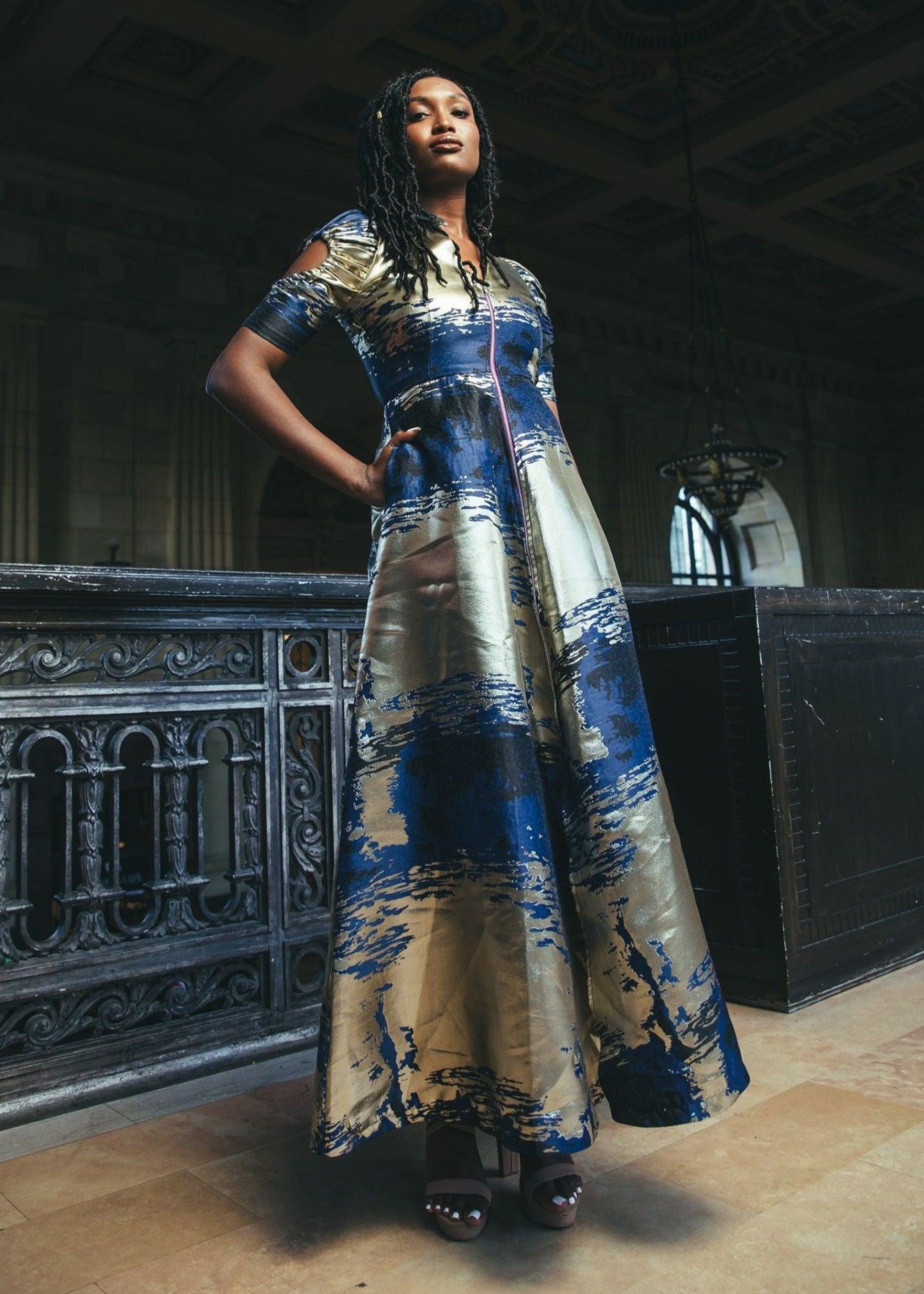
Artisan-made luxury clothing is garment production where named makers, traditional techniques, and documented hours sit behind the label, not anonymous factory output. UNESCO's intangible cultural heritage programme recognizes textile traditions like hand-dyed resist techniques as living heritage, which is exactly the kind of craft that artisan production preserves. At KAHINDO, every piece is designed in New York and handcrafted by female artisans in Kenya, and each garment ships with a provenance card documenting the artisan and the labor hours behind it. That card is the practical difference between a story and proof.

The Greenwashing Audit: Four Claims That Fail
A greenwashing audit tests whether a claim can survive three questions: who verified it, what does it measure, and where is the evidence? Four claims fail that test most often:
| Claim | Why It Fails | What to Ask Instead |
|---|---|---|
| "Sustainable materials" | No defined standard | Which fibers, certified by whom? |
| "Ethically made" | Self-reported | Which factory, at what wage? |
| "Carbon neutral" | Often offsets only | What was measured, and by whom? |
| "Eco-friendly packaging" | Ignores the garment | What about dyeing and fiber? |
If a brand can't answer the follow-up question, the claim is decoration.
Cost-Per-Wear and Resale: The Money Side of Ethics
Cost-per-wear is the price of a garment divided by the number of times you actually wear it. It is the most honest way to compare an ethical piece against fast fashion, because it converts a values argument into arithmetic. The formula is simple: Applying this same rigorous logic to your vanity shelf reveals that true longevity depends on the transparency of ethical sourcing in beauty, ensuring that the items you keep longest are as responsible as they are enduring.
Cost per wear = purchase price ÷ number of wears
A $400 dress worn 100 times costs $4 per wear. A $40 dress worn five times costs $8 per wear. The cheaper garment is twice as expensive per outing, and that is before you account for the fact that the $40 dress is more likely to pill, fade, or lose its shape within a season, which is precisely why it gets worn five times instead of a hundred.
Running the Numbers on a Real Purchase
How Resale Changes the Math
Resale is where the financial case for ethical luxury gets strongest, and it is the angle most competing articles skip entirely. A garment with documented provenance and durable construction holds value on the secondary market in a way that anonymous fast fashion does not. Three mechanics drive that:
- Brand recognition and scarcity. Limited runs and named collections resell for a meaningful fraction of retail, while mass-produced items typically resell for a small fraction of their already-low price.
- Documented provenance. A provenance card, named artisan, or traceable production record gives a resale buyer something to verify, and verifiable goods command higher prices than anonymous ones.
- Condition durability. Natural fibers, reinforced seams, and colorfast dyes survive repeated wear and cleaning, which is what makes a garment resellable years later instead of disposable.
The resale market also has an ethical dimension that cuts both ways. On one hand, resale extends a garment's life, keeps it out of landfill, and reduces demand for new production. On the other, the resale boom has created its own problems: counterfeit risk, unclear labor conditions in resale sorting and fulfillment, and the fact that resale platforms often profit from volume rather than from durability.
The Trade-Offs Nobody Mentions
Cost-per-wear is not a universal win. Three honest caveats:
- It requires a high number of wears. If you wear a piece twice a year, the math does not favor the expensive garment. Cost-per-wear rewards frequency, not price alone.
- It assumes the garment survives. A poorly constructed expensive garment can have a worse cost-per-wear than a cheap one. Price is not a proxy for durability.
- It ignores resale friction. Selling a garment takes time, platform fees, and shipping. The resale value is real, but it is not instant liquidity.
Ethical luxury is not only a values purchase. When the garment is well made, worn often, and resellable, it is frequently the cheaper one over time, and the resale market is what makes that math work. The brands worth buying are the ones that design for that outcome on purpose.
Conclusion
Judging which luxury brand is most ethical comes down to verification, not vibes: named makers, documented wages, real certifications, and a supply chain you can trace. KAHINDO was built for exactly that standard, with fair-trade production by female artisans in Kenya, original prints rooted in Congolese textile traditions, and a provenance card in every garment. Shop the Blue Ombré collection and wear a piece whose story you can actually check.
Frequently Asked Questions
How do luxury brands define ethical production?
There is no single legal definition. In practice, ethical luxury production means paying workers a living wage, using eco-friendly materials with traceable origins, limiting environmental impact across the supply chain, and disclosing who made each garment and where. Brands that publish factory lists, wage policies, and third-party audits come closest. Those that only use words like 'conscious' or 'responsible' without documentation are defining nothing at all.
Are there independent certifications for ethical luxury fashion?
Yes. The most recognized include Fair Trade Certified, B Corp, GOTS for organic textiles, and bluesign for chemical safety in production. These require third-party audits rather than self-reporting, which is what separates them from in-house 'sustainability pledges.' A brand carrying one or more of these has opened its operations to outside inspection. A brand with none is asking you to take its word for it.
What makes a luxury brand truly sustainable versus greenwashing?
The difference is verifiable proof. A genuinely sustainable brand can name its suppliers, show audit results, and explain how a garment was made from fiber to finish. Greenwashing relies on vague language: 'eco-friendly collection,' 'planet-positive,' or a single recycled-fabric capsule while the rest of production stays unchanged. If a claim cannot be checked against a certificate, a named factory, or a published report, treat it as marketing until proven otherwise.
How does artisan-made luxury clothing compare to mass-market luxury?
Artisan-made luxury clothing is produced in small batches by named makers, often with hand-dyed or hand-woven textiles that cannot be replicated exactly. Mass-market luxury scales through factories where individual makers are anonymous. The practical differences show up in fit, fabric character, and longevity. The trade-off is limited stock and longer lead times.
Are luxury brands required to disclose their supply chain transparency?
There is no U.S. federal law forcing fashion brands to publish full supplier lists. Some states, like California, require large companies to disclose efforts to eliminate forced labor, and the FTC can act against false environmental claims under its Green Guides. Beyond that, disclosure is voluntary. That is why supply chain transparency is a useful test: a brand that publishes its factories and wages is choosing to be accountable when it does not have to be.