


Article: Choosing Comfortable Heels for All-Day Wedding Wear
Choosing Comfortable Heels for All-Day Wedding Wear
Last Updated: October 22, 2026
Quick Summary
Choosing comfortable heels for all-day wedding wear starts with fit, not style: measure your foot late in the day, leave a finger's width in the toe box, and walk at least twenty steps before deciding. Pick a stable base and modest heel height, then break the pair in over short, repeated sessions well before the event.
- A low block heel distributes weight across the whole heel and outlasts a stiletto at the reception.
- A firm heel counter holds the heel vertical and prevents the overpronation that causes arch fatigue.
- Break in heels over several short sessions, starting with twenty minutes indoors on day one.
- Match the heel to the venue surface: block heels or wedges for grass, kitten heels for ballroom floors.
- A pair that fails two or more lines of the all-day comfort test is not a wedding shoe.
Table of Contents
- Start With Fit: The Sizing Checklist Most Shoppers Skip
- Best Heels for Standing All Day: Styles That Hold Up
- Wedding Heels With Arch Support: What Actually Helps
- How to Break In Heels Before a Wedding
- Comfortable Shoes for a Wedding Reception: Venue and Surface Guide
- The All-Day Comfort Test: Try This Before You Commit
- Conclusion
- Frequently Asked Questions
Start With Fit: The Sizing Checklist Most Shoppers Skip
Choosing comfortable heels for all-day wedding wear starts with fit, not style. Most shoppers fall in love with a shape online, order their usual size, and discover the problem only after the ceremony begins. At KAHINDO, we think about this the way we think about a dress: the right piece should feel considered from the first step.
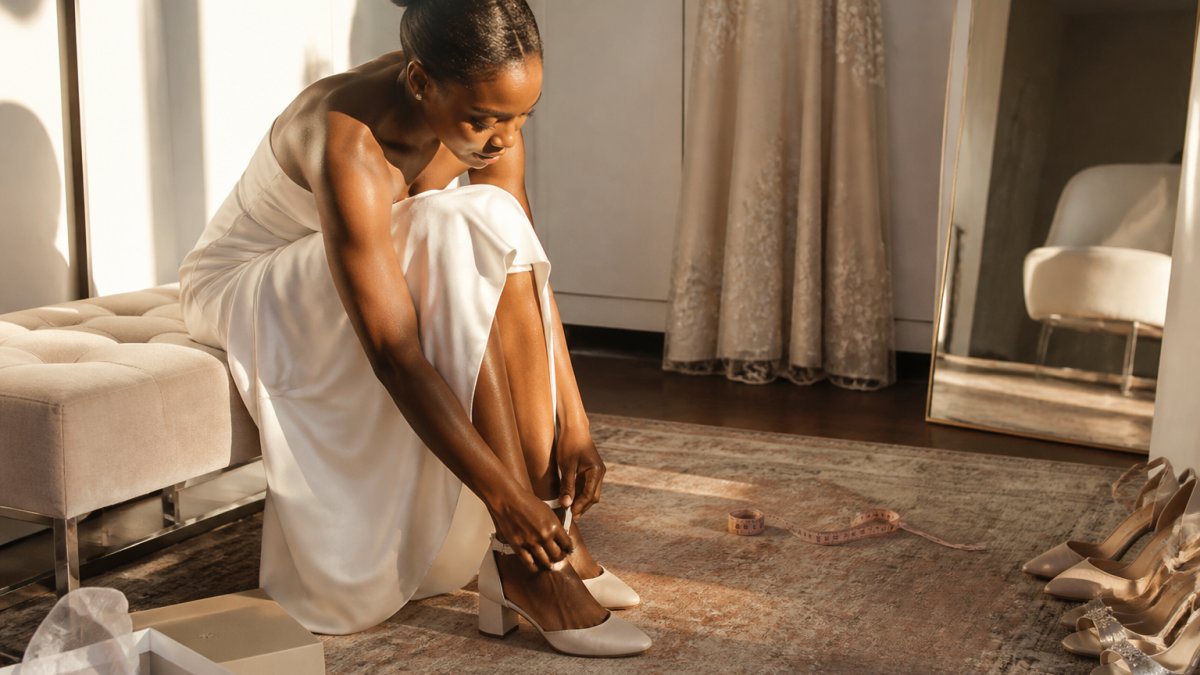
Here is the checklist we would run through before buying any heel:
- Measure your foot late in the day, when it is at its largest.
- Check the toe box: you want a finger's width between your longest toe and the front.
- Test the width across the ball of the foot, where pressure builds.
- Confirm the ankle strap sits snug but not tight against the skin.
- Stand and walk on a hard floor before you commit.
The toe box matters more than heel height for many women. If your toes are pinched, no amount of cushioning will rescue the day.
Best Heels for Standing All Day: Styles That Hold Up
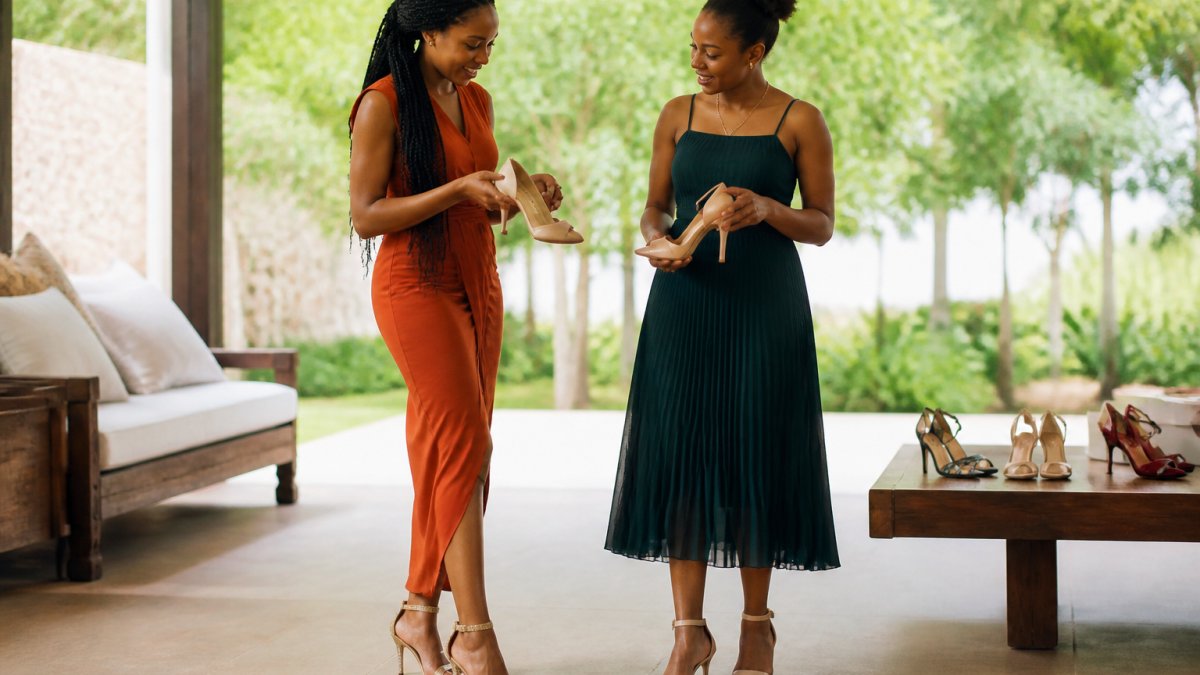
The best heels for standing all day share two traits: a stable base and a modest heel height. A low block heel distributes weight across the whole heel instead of a single point. That is why it outlasts a stiletto at the reception.
A few styles do this well:
- Low block heel: the most reliable choice for grass, stone, and long receptions.
- Sculpted heel: wider at the base, so it stays steady without looking clunky.
- Kitten heel: a two-inch heel that reads elegant and stays wearable for hours.
- Wedge heel: spreads pressure evenly and handles uneven ground.
A three-inch heel can work if the base is wide and the footbed is padded. A thin stiletto over three inches is a photo prop, not a shoe for eight hours of standing.
Wedding Heels With Arch Support: What Actually Helps
Wedding heels with arch support need more than a soft lining.
1. The footbed: molded arch versus flat pad. A flat gel pad compresses under body weight within minutes and does nothing for the arch.
2. The heel counter: firm versus soft. The heel counter is the stiff panel at the back of the shoe.
3. The shank: the hidden spine. Many dress heels hide a steel or composite shank between the insole and outsole.
4. Sole flexibility at the ball: the right kind of bend. You want the shoe to flex where your foot flexes, at the ball, and nowhere else.
5. Materials that breathe and give. Leather linings mold to the foot and breathe; synthetic linings trap heat and stiffen.
Match the support to your foot shape
- High arches: you need a pronounced molded arch and a cushioned forefoot, because high arches concentrate pressure at the ball and heel. A flat pad will feel like nothing.
- Flat feet or overpronation: prioritize a firm heel counter and a shank; a soft shoe lets the arch collapse further.
- Wide forefoot or bunions: look for a wide toe box, soft leather or suede uppers, and a seam-free area over the joint. Avoid pointed toes and stiff patent.
- Swelling-prone feet: choose an adjustable ankle strap or slingback so you can loosen the fit by mid-afternoon, and shop late in the day when the foot is largest.
A platform under the ball of the foot reduces pressure by lowering the effective pitch of the heel, but it does not replace arch support, treat it as a pressure-relief feature, not a support feature.
The American Podiatric Medical Association's guidance on footwear recommends shoes with good arch support and a firm heel counter, which is useful context when you compare styles.
How to Break In Heels Before a Wedding
How to break in heels before a wedding comes down to short, repeated wear, not one long session. Start at home, not on the day.
Try this plan:
- Wear the heels for twenty minutes indoors on day one.
- Add thick socks and walk for ten minutes on day two to soften tight spots.
- Wear them for an hour on day three, including stairs.
- Do a full evening test two weeks out.
- Keep a backup pair of low heels in your bag for the reception.
If a seam rubs, address it early with a blister patch, not on the morning of the event. New shoes need time, and your feet need the practice.
Comfortable Shoes for a Wedding Reception: Venue and Surface Guide
Comfortable shoes for a wedding reception depend on where you will actually be standing. A ballroom floor and a lawn ask different things of a heel.
| Venue surface | Best heel choice | Why it works |
|---|---|---|
| Grass or lawn | Block heel or wedge | Wide base stops sinking |
| Stone patio | Low block heel | Steady on uneven joints |
| Ballroom floor | Kitten heel or low pump | Smooth surface, easy glide |
| Decking | Wedge heel | Spreads weight, no catching |
| Gravel path | Flat or platform sole | Fewer stumbles |
Match the shoe to the surface before you match it to the dress. An outdoor wedding on grass will punish a thin stiletto every time, no matter how beautiful it looks.
The All-Day Comfort Test: Try This Before You Commit
Most advice stops at "wear them around the house." That is not a test, it is a hope. A real all-day comfort test separates the three loads a wedding actually puts on your feet: sustained standing, repeated walking, and short bursts of dancing. Each one fails a shoe in a different way, so test them separately and score the results.
The three-part protocol
Run this over three days, ideally at least two weeks before the event so you still have time to return or exchange the pair.
Part 1, The standing test (20 minutes). Stand still on a hard floor in the shoes, without leaning on anything. This is the load of the ceremony, the receiving line, and cocktail hour.
Part 2, The walking test (30 minutes). Walk on a hard floor, then on carpet, then up and down a full flight of stairs.
Part 3, The dancing test (15 minutes). Put on the music and move the way you actually will, turns, side steps, a few jumps if the song calls for it. This is the load of the reception.
Score each pair before you commit
Use a simple pass/fail on each line. A pair that fails two or more lines is not a wedding shoe, no matter how good it looks.
- No pinching in the toe box after 20 minutes of standing
- Heel stays put without gripping with your toes
- Arch feels supported when standing still, not just when walking
- No rubbing at the ankle strap or heel counter after 30 minutes
- You can walk a full flight of stairs at a normal pace with confidence
- No forward slide into the toe box during the dancing test
- You can loosen the strap by one notch by mid-afternoon without the shoe slipping off
Know the signs a pair is unsuitable
Some failures are fixable with an insert, a heel grip, or a blister patch. Others are structural and will not improve:
- A heel that slips more than a quarter inch, the last is the wrong shape for your heel; a grip pad may help, but a shoe that needs two pads is the wrong shoe.
- Toes that go numb or tingle, the toe box is too shallow or too narrow; no amount of breaking in will widen it enough.
- A burning arch after 20 minutes of standing, the footbed has no real arch support; an insert can help only if there is room for one without crowding the toes.
- Ankle rolling outward, the heel counter is too soft or the heel is too tall for your ankle stability; choose a lower, wider heel.
- A seam that rubs in the same spot every time, this will become a blister on the day; return the pair rather than plan around a patch.
The same thinking applies to the rest of your look. KAHINDO designs occasionwear for weddings and celebrations, and we believe a dress and a shoe should both carry you through the whole day. Our pieces are handcrafted by female artisans in Kenya, with original prints and considered silhouettes, so the outfit feels as good at the last dance as it did at the first.
Conclusion
Finding comfortable heels for all-day wedding wear is a matter of fit, surface, and honest testing, not luck. Start with the sizing checklist, choose a stable heel shape, and break the pair in well before the event.
At KAHINDO, we build occasionwear for women who want to feel confident from the ceremony to the last song. Explore our wedding guest dresses, bridesmaid dresses, and eveningwear, each handcrafted with fair-trade care. Get started with KAHINDO and step into the day feeling as good as you look.
Cleveland Clinic's advice on choosing comfortable shoes
Frequently Asked Questions
What are the most comfortable heels for wearing all day at a wedding?
Low block heels and kitten heels tend to be the most comfortable for all-day wedding wear because they spread weight across a wider base and keep heel height under three inches. Look for a padded footbed, a roomy toe box, and an adjustable ankle strap. A two-inch block heel is often the sweet spot for standing, walking, and dancing without the ball-of-foot pressure that comes with stilettos.
How can I break in new heels before the wedding day?
Start wearing your heels indoors for 20 to 30 minutes a day, a week or two before the event. Add thin socks to stretch tight spots, and use a heel grip or moleskin on any area that rubs. Gradually increase wear time and practice walking on carpet, tile, and outdoors. This gives you a realistic sense of how the shoes behave over eight to nine hours, not just the first five minutes.
Are block heels more comfortable than stilettos for a wedding?
Yes, block heels are generally more comfortable than stilettos for a wedding. The wider heel base improves foot stability and reduces the wobble that tires your ankles and calves. Stilettos concentrate pressure on a small point and put more load on the ball of the foot. If you love the look of a stiletto, save it for a short cocktail hour and switch to a low block heel for the reception.
What should I look for when trying on heels for a wedding?
Try heels on late in the day when feet are slightly swollen, and stand and walk for at least five minutes. Check that your toes have room to spread in the toe box, the arch support matches your foot shape, and the ankle strap holds without digging in. Test the heel height by rising onto your toes, and make sure you can walk confidently on a hard floor. Bring the dress or a similar hem length to see the full look.