

The Leopards Drew with Portugal. Here's Why It's Bigger Than Football

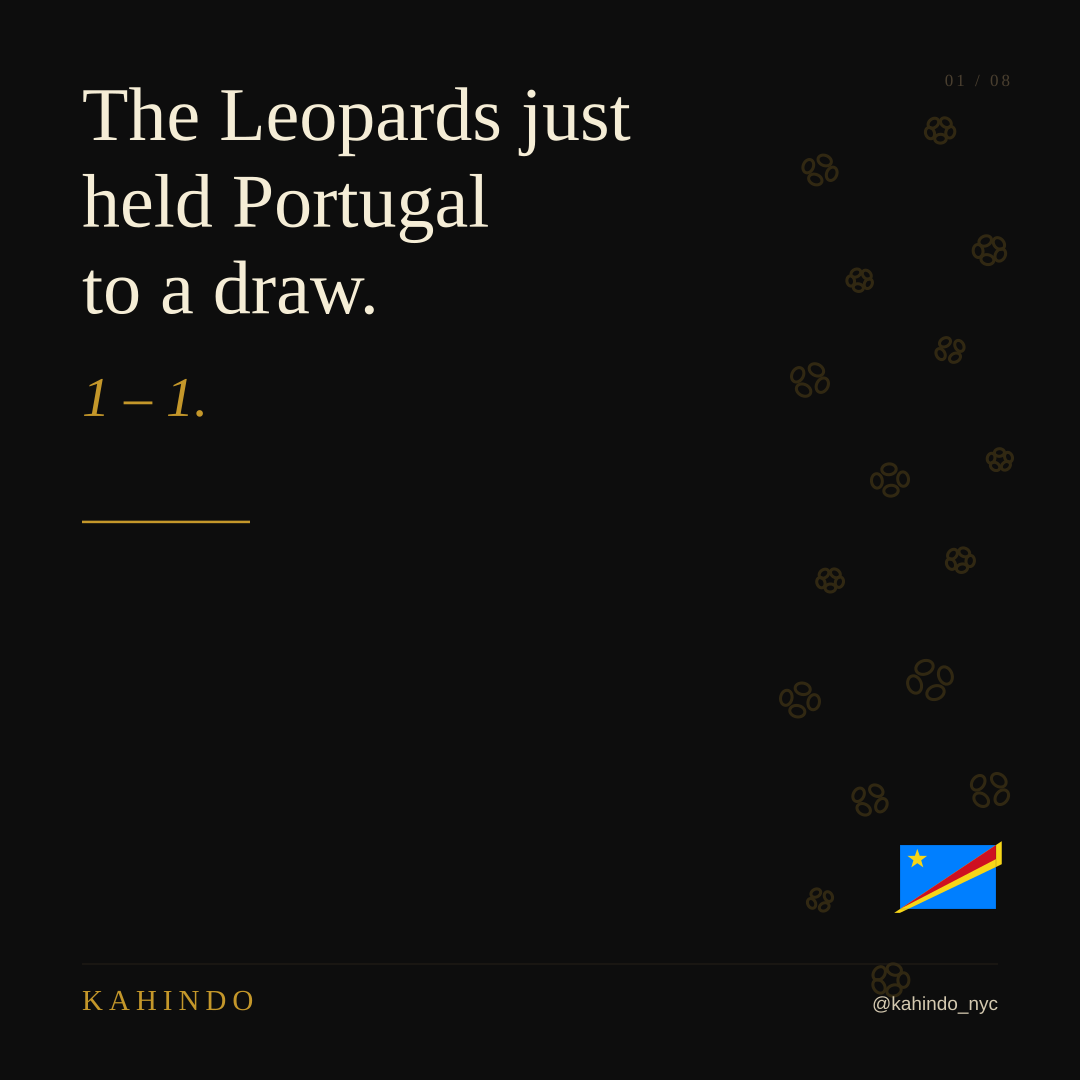
Last night in Houston, the Democratic Republic of Congo held Cristiano Ronaldo's Portugal to a 1–1 draw at the 2026 FIFA World Cup.
It was their first World Cup match since 1974. Their first point ever on football's biggest stage. Yoane Wissa's header in first-half stoppage time cancelled out João Neves' early opener — and the Leopards held on through five minutes of Portugal pressure to earn something historic.
But the story started before a single ball was kicked.
They Arrived Dressed as Themselves
When the DR Congo team landed in Houston, they walked off the plane in leopard-embellished black suits and leopard-print bags — designed by Alvin Mak, a self-taught Congolese creative based in Paris with fewer than 10,000 Instagram followers before this week.
One image. The entire world curious.
The questions came fast:
"Who designed them?"
"What does the leopard represent?"
"What is La Sape?"
"Why does this matter?"
And then they went on the pitch and answered a different question — whether Congo belonged on that stage — with a resounding yes.

They Are, Literally, The Leopards
Here's what most coverage is missing: the DR Congo national football team isn't just called DR Congo. They are The Leopards.
The leopard-embellished suits Alvin Mak designed weren't a stylist's clever choice or a fashion moment engineered for social media. They were an identity declaration. The team arrived dressed in who they are.
In Congolese culture, the leopard has carried weight for generations — a symbol of strength, resilience, and sovereignty. It was the emblem of Mobutu's Zaire, reclaimed and stripped of its political charge by the Sapeur movement, and refashioned as something simpler and more profound: cultural pride.
When those suits walked into the stadium, that history walked in with them.
What Is La Sape?
La Sape — the Société des Ambianceurs et des Personnes Élégantes — is a movement born in Kinshasa and Brazzaville built on a radical idea: that how you dress is how you assert your humanity.
In the context of post-colonial Congo, where African identity was systematically diminished, Sapeurs turned tailoring into resistance. A perfectly pressed suit in a market. Italian leather shoes on unpaved streets. Not contradiction — authorship.
My father was a Sapeur.
He taught me, without ever saying it directly, that clothes are not decoration. They are communication. They are dignity made visible.
That lesson is the founding spirit of KAHINDO.

Provenance Is the Asset
There's a principle I keep returning to: a bag is leather and labour. "Made in Italy" is what defines the price. Once an African technique is documented and held by an institution, the same mechanism applies — heritage becomes a cultural asset that can be protected, attributed, and licensed.
The DRC team's arrival made that argument to billions of people watching the World Cup. In real time. Before kickoff.
One image became a search. A search became a question. A question became a conversation about a country the world usually encounters through a crisis lens — conflict, extraction, displacement.
This week, for once, the entry point was culture. Creativity. Authorship.
"It's been interesting seeing the world become curious about Congo through culture rather than crisis."
— Aurelie Rivkah
There's no telling the domino effect of that kind of awareness.
Why This Is Personal
I'm Kahindo — Founder and Creative Director of KAHINDO, an ethical luxury womenswear brand designed in New York and handcrafted by female artisans in Africa.
I was born in Uganda to Congolese parents. I was raised across East and West Africa — Ethiopia, Niger, Nigeria, Kenya. I was shaped by a father who dressed with exactly the kind of intention the world is suddenly paying attention to.
I built KAHINDO in 2017 on the belief that African craftsmanship deserves to sit at the luxury table — not as a footnote to someone else's aesthetic, but as the primary author of its own story.
For nine years, I've been making that argument in fabric and stitch. The Leopards just made it to five billion people. In leopard suits. Before they'd touched a ball.
And then they held Ronaldo.

What This Means for African Fashion
Alvin Mak — self-taught, Congolese, based in Paris, under 10K followers before Monday — just dressed the most-talked-about team at the 2026 World Cup.
That is not a small thing.
It tells every African designer, every Black creative building at the intersection of culture and craft: your provenance is the asset. Your story is the strategy. Your identity is not a niche — it is a thesis.
The world is not discovering African luxury. It is finally beginning to see what has always been there.
The Leopards showed up dressed like themselves. They earned a historic point against one of the most decorated squads in the tournament. And before any of that happened, they made the world curious about Kinshasa.
That is cultural authorship at its most powerful.
The Invitation
If you found yourself asking "What is La Sape?" this week — welcome. That curiosity is the beginning of something.
KAHINDO exists at exactly this intersection: African heritage, ethical production, luxury design. Every piece we make is handcrafted by female artisans in Africa and designed with the same conviction the Sapeurs have carried for decades — that beauty is a form of dignity, and dignity is non-negotiable.
The Leopards reminded the world of that on the biggest stage in sport.
We've been saying it in fabric since 2017.
Fashion That Looks Good, Feels Good & Does Good.
Shop the Collection 🐆Designed in New York · Handcrafted in Africa